
By Ella Davar, RD, founder of the Gut-Brain Method and Women's Health Ambassador with the HHS Office on Women's Health
The anti-inflammatory diet is the only longevity diet I would recommend as a licensed nutrition professional. This guide is the evidence-based framework I use in practice and teach in the Gut-Brain Method™ Certification, with the peer-reviewed reference behind every number.
It is written for dietitians, physicians, nurses, coaches and other health professionals. If you are not a clinician, use it to start a conversation with yours.
1. The foundation: an anti-inflammatory, Mediterranean-style pattern
The strongest randomized evidence for a longevity eating pattern points to a Mediterranean, anti-inflammatory diet.
PREDIMED. 7,447 adults at high cardiovascular risk were randomized to a Mediterranean diet with extra-virgin olive oil or nuts, or a control diet. Major cardiovascular events fell by about 30%. The result held when the trial was reanalyzed and republished in 2018 (Estruch et al., 2018).
Fruit and vegetables. About five servings a day, two of fruit and three of vegetables, was linked to a 13% lower risk of death (Wang et al., 2021).
Nuts. People who ate a handful of nuts daily had about a 20% lower risk of death over 30 years of follow-up (Bao et al., 2013).
In practice, I build every plan on this foundation, then personalize it with data.
2. Macronutrients, dosed like a clinician
Protein: muscle is a longevity organ
Protein preserves lean mass, supports immune function and steadies blood sugar. Targets per kilogram of body weight a day:
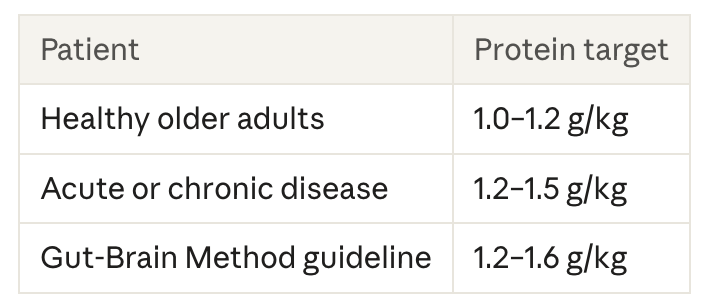
The first two rows come from the PROT-AGE Study Group (Bauer et al., 2013). Food first: 4 oz salmon ≈ 25 g, 2 eggs ≈ 12 g, ½ cup cooked lentils ≈ 9 g, 1 oz pumpkin seeds ≈ 8 g.
Fats: test, don't guess
I measure the omega-6 to omega-3 ratio before I adjust fats. Then I build the plate on unsaturated fats:
Extra-virgin olive oil: 1–2 tbsp a day
Nuts: 1 oz, about a handful, a day
Avocado: ½ a day
Oily fish such as salmon, sardines or mackerel: twice a week, as the American Heart Association recommends
Carbohydrates: quality and fiber
Carbohydrates are not the enemy; low-fiber, refined ones are. Fiber targets are 25 g a day for women and 38 g for men, and most adults get about half that. In a series of meta-analyses, people with the highest fiber intakes had 15–30% lower all-cause and cardiovascular mortality than those with the lowest (Reynolds et al., 2019).
1 cup raspberries ≈ 8 g fiber
½ cup cooked lentils ≈ 8 g fiber
1 tbsp chia seeds ≈ 4 g fiber
½ cup quinoa or 1 small sweet potato for steady energy
3. The microbiome: diversity, not monotony
Fermented foods moved the microbiome faster than fiber in a controlled trial. A 10-week Stanford study randomized 36 healthy adults to a fermented-food or a high-fiber diet (Wastyk et al., 2021):
On the fermented-food diet, microbiome diversity increased, and more with larger servings.
19 inflammatory proteins fell, including IL-6.
On the high-fiber diet, diversity stayed stable on average.
Plant variety matters too. People who ate 30 or more different plants a week had more diverse gut microbiomes than those who ate 10 or fewer (McDonald et al., 2018). Herbs, spices, nuts, seeds, beans and whole grains all count.
In practice: include probiotic-rich foods like sauerkraut, kimchi, pickles, yogurt and kefir, plus a diverse range of plant foods, to support a healthy balance of gut bacteria. Fiber-rich vegetables contain prebiotics that fuel those bacteria, so I include leafy greens at every meal.
4. Personalization: same meal, different patient
The same food does not do the same thing in every body. Across 46,898 meals in about 800 people, blood glucose responses to identical foods varied widely from person to person (Zeevi et al., 2015). That is the clinical case for continuous glucose monitoring.
Protein first. Meal order changes the response too. In a small trial of 11 adults with type 2 diabetes, eating protein and vegetables before carbohydrates lowered glucose by 29–37% in the first hour and lowered insulin (Shukla et al., 2015). Think fish with asparagus, or chicken with broccoli, before the starch.
What I measure before I prescribe
Gut: comprehensive stool test
Inflammation: inflammatory markers and the omega-6 to omega-3 ratio
Micronutrients: a functional blood panel
Glucose: HbA1c and a continuous glucose monitor
Hormones: cycle mapping and cortisol, when indicated
5. The micronutrients I check first
These three are often low, and food can close much of the gap.

Vitamin D and magnesium figures are from the NIH Office of Dietary Supplements; the fish recommendation is from the American Heart Association.
6. What I remove, and what replaces it
Elimination works best when every removal has a replacement. These swaps come from my anti-inflammatory food shopping list.
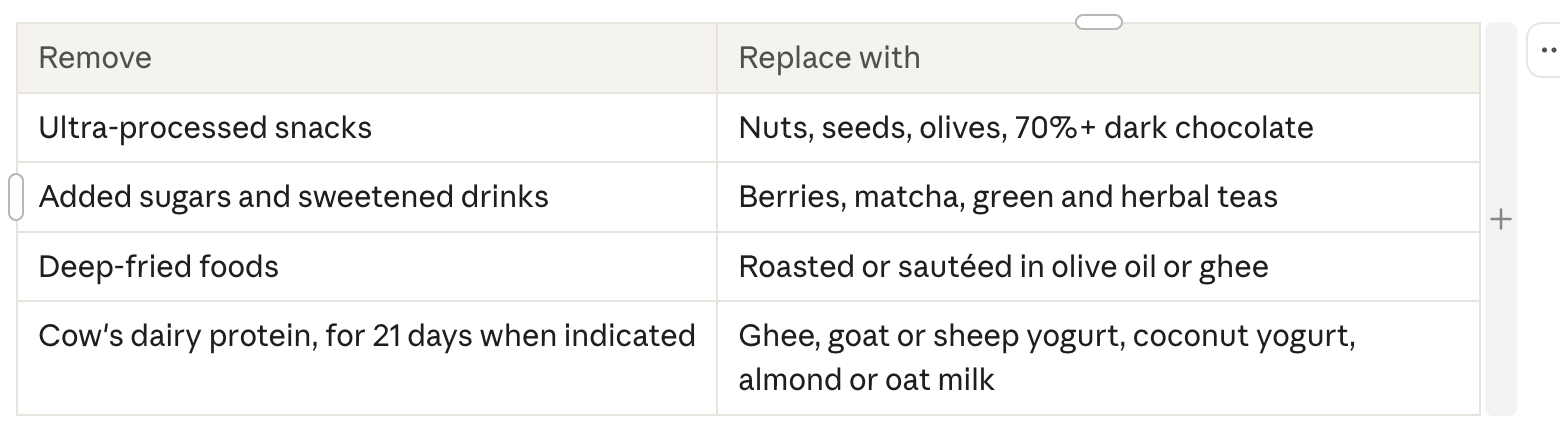
7. The daily template I give clients
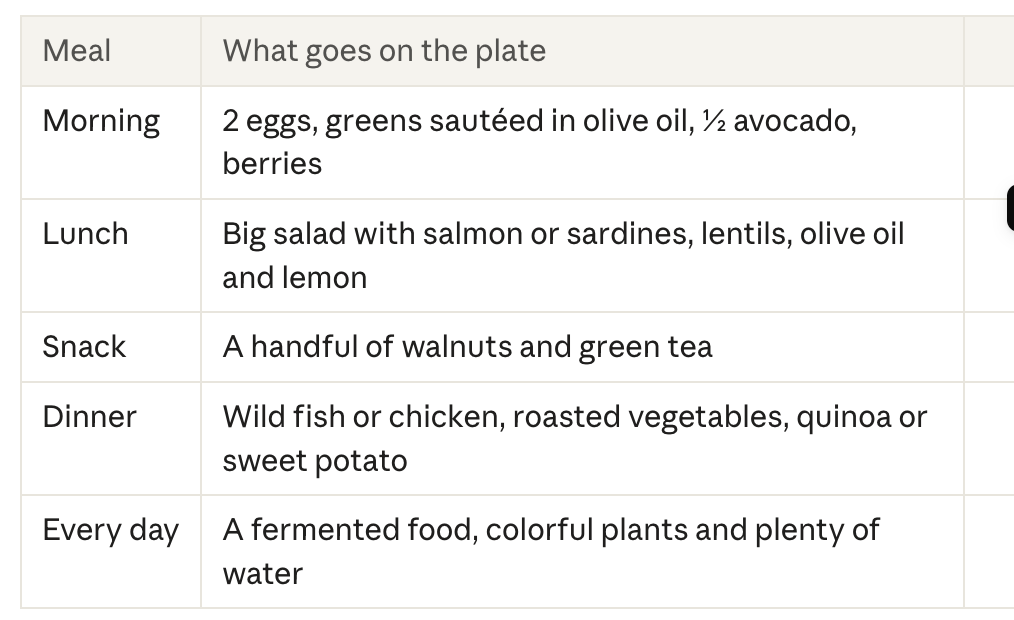
It is a starting template. Lab results, glucose data and symptoms decide what changes from there.
Bring this into your practice
Gut-Brain Method™ Certification. A 9-week online program for dietitians, physicians, nurses, coaches and practitioners who want to build a protocol-driven practice. It covers gut-brain inflammation, the microbiome, infections, digestion and metabolic imbalances. View the certification program at gutbrainmethod.com
Global Longevity Association. The world's leading network for longevity industry professionals, built on evidence-based healthspan. Join the movement. Explore membership at globallongevityassociation.org
Global Longevity Summit. The Mar-a-Lago Club, Palm Beach, November 19, 2026.
If a colleague belongs in this conversation, send them this guide.
References
Bao Y, et al. Association of nut consumption with total and cause-specific mortality. N Engl J Med. 2013;369:2001–2011. doi:10.1056/NEJMoa1307352
Bauer J, et al. Evidence-based recommendations for optimal dietary protein intake in older people: a position paper from the PROT-AGE Study Group. J Am Med Dir Assoc. 2013;14:542–559. doi:10.1016/j.jamda.2013.05.021
Estruch R, et al. Primary prevention of cardiovascular disease with a Mediterranean diet supplemented with extra-virgin olive oil or nuts. N Engl J Med. 2018;378:e34. doi:10.1056/NEJMoa1800389
McDonald D, et al. American Gut: an open platform for citizen science microbiome research. mSystems. 2018;3:e00031-18. doi:10.1128/mSystems.00031-18
Reynolds A, et al. Carbohydrate quality and human health: a series of systematic reviews and meta-analyses. Lancet. 2019;393:434–445. doi:10.1016/S0140-6736(18)31809-9
Shukla AP, et al. Food order has a significant impact on postprandial glucose and insulin levels. Diabetes Care. 2015;38:e98–e99. doi:10.2337/dc15-0429
Wang DD, et al. Fruit and vegetable intake and mortality. Circulation. 2021;143:1642–1654. doi:10.1161/CIRCULATIONAHA.120.048996
Wastyk HC, et al. Gut-microbiota-targeted diets modulate human immune status. Cell. 2021;184:4137–4153. doi:10.1016/j.cell.2021.06.019
Zeevi D, et al. Personalized nutrition by prediction of glycemic responses. Cell. 2015;163:1079–1094. doi:10.1016/j.cell.2015.11.001
National Academies. Dietary Reference Intakes for energy, carbohydrate, fiber, fat, fatty acids, cholesterol, protein and amino acids. 2005.
NIH Office of Dietary Supplements. Vitamin D and magnesium fact sheets for health professionals. ods.od.nih.gov
This guide is educational content for health professionals and is not individual medical advice.
